
AI Courses in India 2026: Why Two Programmes Cost the Same and Teach Different Decades
A ₹1.5 lakh course and another ₹1.5 lakh course can differ by an entire technology generation. The module list is the only place that shows it.
A ₹1.5 lakh course and another ₹1.5 lakh course can differ by an entire technology generation. The module list is the only place that shows it.
There is no shortage of AI training in India. There is a shortage of AI training that reaches the part of the job market that is actually growing.
An analysis of nine widely advertised programmes, scored on their published curricula rather than their marketing pages, found that five sit in the light band on production operations. Most treat autonomous agents as a topic to mention rather than a system to build.
The distinction is invisible at the point of purchase, and it is the one that shows up in an interview.
The Demand Is Structural, Not a Spike
Bain & Company puts India’s available AI talent at roughly 1.2 million against demand close to twice that figure. The firm estimates executive AI openings may exceed 2.3 million by 2027, with 44% of executives naming insufficient in-house AI skills as a primary obstacle.
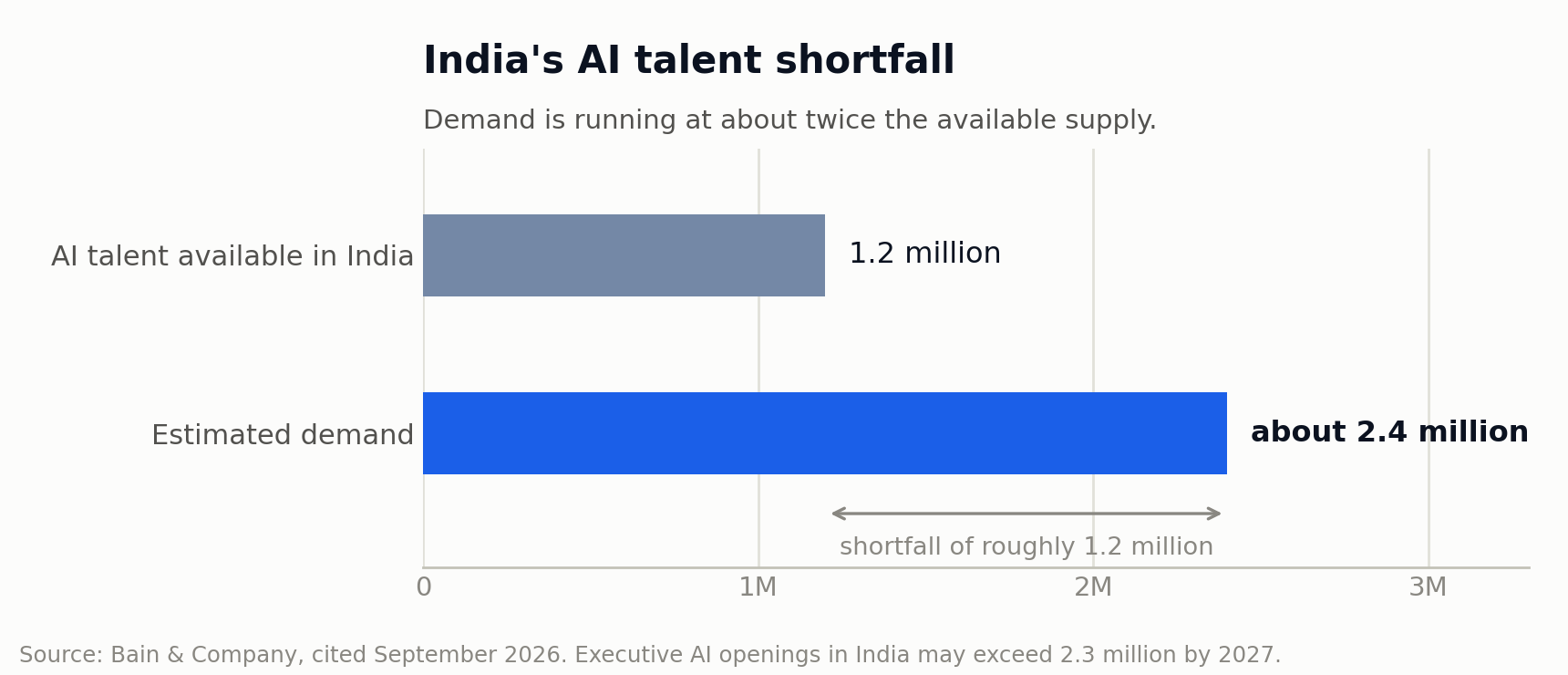
Deloitte and NASSCOM project India’s AI talent pool rising from about 600,000 to 650,000 in 2022 to more than 1.25 million by 2027. Even at that growth rate, supply arrives late.
The composition of work is shifting alongside the volume. NITI Aayog projects IT services employment falling from 7.5 to 8 million in 2023 to around 6 million by 2031, while AI-related jobs could grow by up to 4 million. Current AI talent demand already sits at roughly half the existing total.
PwC’s Global AI Jobs Barometer 2026 measures what that scarcity is worth: a 62% pay premium for AI skills, up 5 points year on year, with AI roles growing 69% against a 9% rise in job roles overall.
The Premium Is Not Evenly Distributed
Within India, the premium concentrates in specific titles rather than spreading across everything labelled AI.
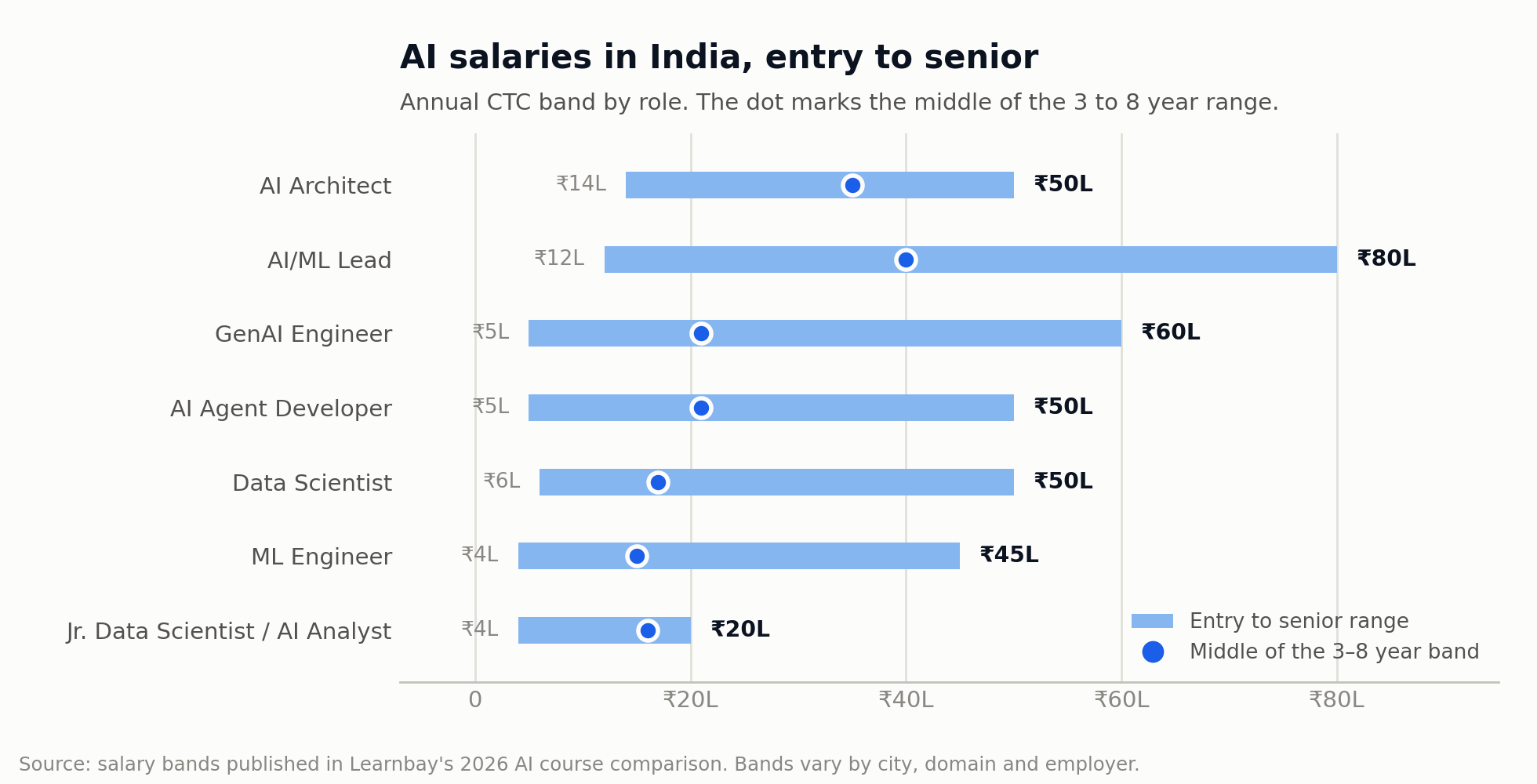
A GenAI Engineer starts at ₹5 to 9 LPA and reaches ₹30 to 60 LPA at senior level. An AI Agent Developer follows a comparable path, with team leads passing ₹80 LPA. An AI Architect enters at ₹14 to 24 LPA, higher than most roles exit at.
At the other end, a junior data scientist or AI analyst tops out near ₹20 LPA.
Both ends of that chart are reachable from a course. Which end a learner lands on depends heavily on whether the syllabus reached agents, retrieval systems and production deployment, or stopped at model building.
Nine Programmes, Compared on Price
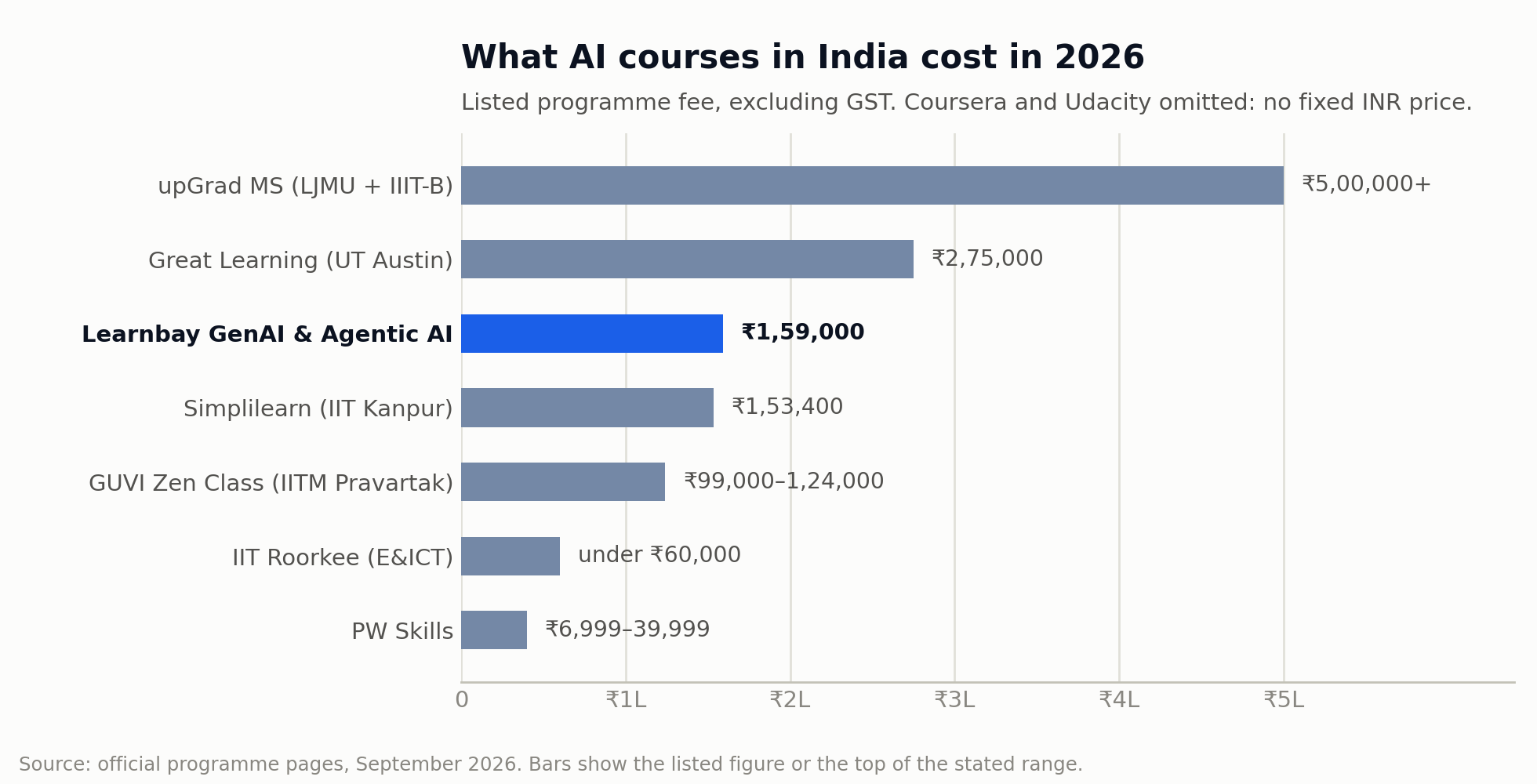
Listed fees span two orders of magnitude.
Programme | Provider | Format | Duration | Listed fee | Certification |
|---|---|---|---|---|---|
Learnbay | 100% live + AI Co-Lab | 9 months | ₹1,59,000 + GST | IBM, Microsoft, IIT Patna | |
AI & ML Certification | IIT Roorkee (E&ICT) | Live + recorded | 6 months | Under ₹60,000 | IIT Roorkee E&ICT |
MS in Machine Learning & AI | upGrad | Online degree | 18 months | Above ₹5,00,000 | LJMU + IIIT-B, WES-accredited |
Professional Certificate in GenAI & ML | Simplilearn | Live online | 11 months | ₹1,53,400 | IIT Kanpur |
PGP in AI & ML | Great Learning | Online micro-classes | 12 months | ₹2,75,000 | UT Austin McCombs |
AI & ML Zen Class | GUVI (HCL) | Live, weekends, vernacular | 5 to 6 months | ₹99,000 to ₹1,24,000 | IITM Pravartak |
AI Nanodegrees | Udacity | Self-paced + project reviews | 3 to 4 months | Varies by track | Udacity |
Generative AI for Everyone | Coursera | Self-paced | A few hours | Subscription | DeepLearning.AI |
Data Science with GenAI | PW Skills | Recorded + live | 8 months | ₹6,999 to ₹39,999 | PW Skills |
Price sorts these programmes into bands that say more about what is bought than what is taught.
Below ₹60,000 buys self-paced or lightly live content, completion certificates and project review. IIT Roorkee adds an institute credential at that level, which is unusual value. What the band does not buy is live mentoring depth or accountability, and completion rates suffer accordingly.
Between ₹60,000 and ₹2,00,000 sits the live, mentor-led tier: Learnbay, Simplilearn and GUVI. Industry certificates, real projects and career services come with it. A formal academic degree does not.
Above ₹2,00,000, Great Learning sells a global university credential with small cohorts. Above ₹5,00,000, upGrad sells an accredited master’s with WES portability, bought mainly for visa and credential evaluation rather than speed.
Where the Curricula Actually Diverge
The price table and the curriculum table do not agree, which is the finding worth acting on.
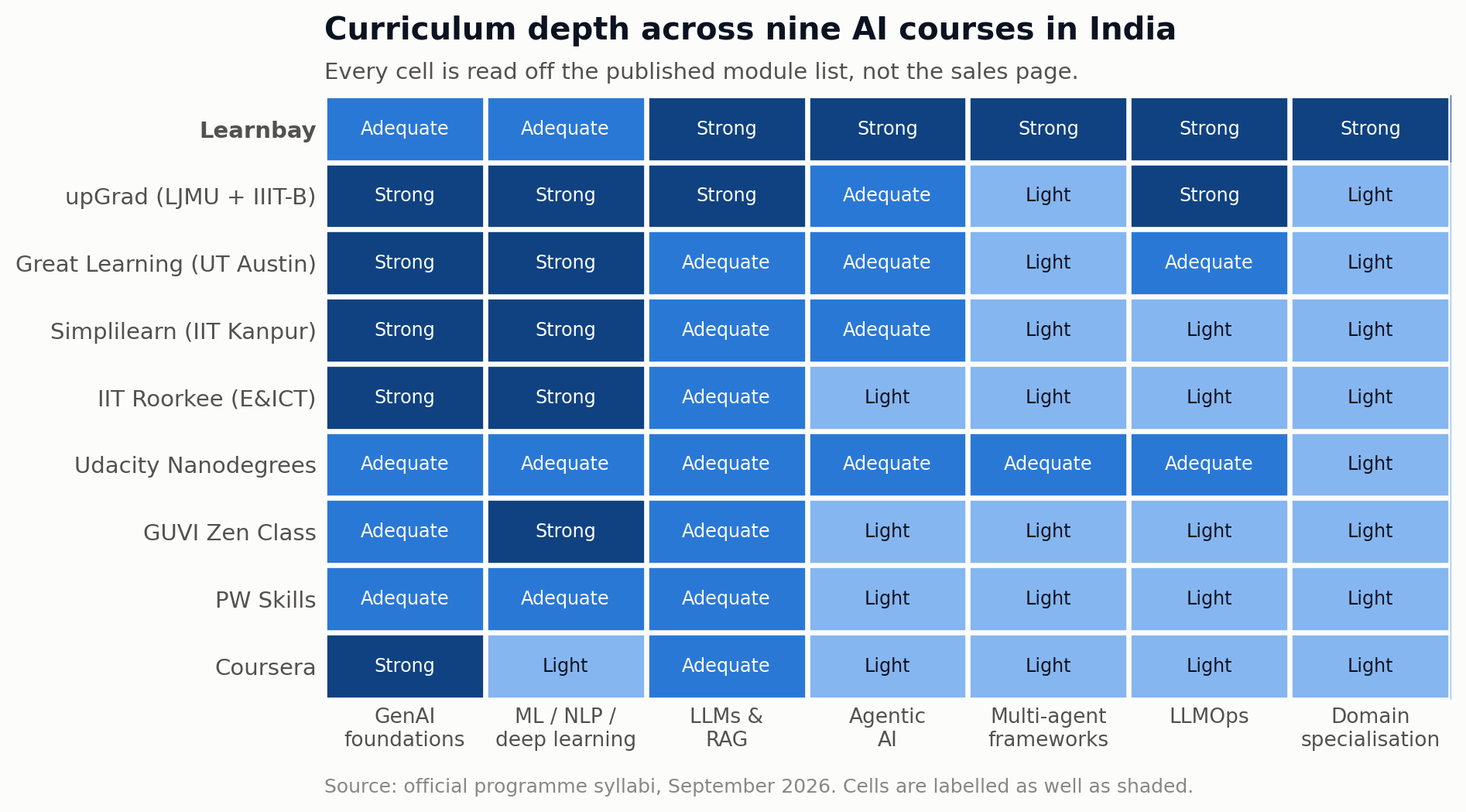
Foundations are a solved problem. GenAI basics, machine learning, NLP and deep learning appear in strength across upGrad, Great Learning, Simplilearn, IIT Roorkee and GUVI. A learner who needs only fundamentals has many workable options, several inexpensive.
Agentic AI is where the market thins out. IIT Roorkee, GUVI, PW Skills and Coursera all sit in the light band. Great Learning, Simplilearn and upGrad reach adequate. Learnbay is the only programme in this set rated strong on both agentic AI and multi-agent frameworks, and it pairs that with production RAG.
LLMOps is the widest single gap. Five of the nine are light on it. Only upGrad and Learnbay are rated strong. This is the layer covering deployment, monitoring, versioning and cost control, and it is what separates a notebook demo from something a company will run. Given that AI Agent Developer and GenAI Engineer sit at the top of the salary chart, a syllabus that skips this layer is not competing for those roles.
Domain specialisation is rarer than any technical topic. Only Learnbay is rated strong on mapping the curriculum to a learner’s existing industry. For a professional switching from banking, manufacturing or healthcare, that mapping is the difference between a generic capstone and one that reads as relevant experience.
Udacity is a useful outlier. Its depth varies entirely by chosen Nanodegree, which makes it strong within a narrow track and light on breadth. Coursera’s Generative AI for Everyone is an interest-check measured in hours, and should be treated as one.
The Mistakes That Cost the Most
Six patterns recur among learners who regret the spend.
- Choosing a programme designed for a different learner profile
- Prioritising brand reputation over the skills actually taught
- Assuming recorded content is equivalent to live instruction
- Changing two variables at once, switching both domain and function
- Enrolling on the strength of a guaranteed-placement claim
- Not finishing, because nothing external enforced the schedule
The fourth is underrated. A test engineer moving into GenAI engineering has changed function. Moving into GenAI engineering in a new industry at the same time changes two things, and interviewers notice.
A Short Pre-Enrolment Checklist
Curriculum. Does the syllabus cover agentic AI, RAG and LLMOps, or stop at prompt engineering? When was it last updated? Does it name frameworks such as LangGraph or LangSmith? Is there a role-specific or domain-specific track?
Delivery. Are sessions genuinely live? What happens when one is missed, a recording, a make-up class, or nothing? Do weekday and weekend batches both exist, with the option to switch?
Certification. What exactly does the partner brand certify, the full programme or a single module? Is there a separate project certificate?
Career support. Which companies hired recent graduates, and into what roles? Does support mean targeted outreach or mass resume distribution?
Cost. Does the quoted price include 18% GST? Is the no-cost EMI genuinely free? Are there bonds or income-share agreements afterwards?
None of the nine programmes guarantees a job, and none should be expected to. A provider that promises one has answered a different question than the one worth asking.
FAQs
Which AI course in India is best in 2026? It depends on the starting point. Working professionals who want agentic AI, production RAG and LLMOps in one live programme match best to Learnbay’s GenAI and Agentic AI Master Program. Learners who want an IIT credential cheaply should look at IIT Roorkee’s E&ICT certification. Anyone who needs an internationally portable degree should consider upGrad’s MS with LJMU and IIIT-B. For a first look at the field, Coursera or PW Skills costs little.
Which AI skills carry the highest premium? Agent development, retrieval systems and production operations. Those skills map to the GenAI Engineer and AI Agent Developer bands at the top of the salary chart, and they are exactly the topics most syllabi cover lightly.
How much should an AI course in India cost? Live, mentor-led programmes with career support sit between ₹99,000 and ₹2,75,000. Below ₹60,000 buys content rather than accountability. Above ₹5,00,000 buys an accredited degree, which is a different product with a different purpose.
Do AI courses in India guarantee placement? No. Every programme compared here uses assistance wording. Prospective learners should ask which companies hired recent graduates, into which roles, and get the refund terms in writing before paying.
Fees, durations and syllabus details were taken from official programme pages in September 2026 and are subject to change. No provider in this comparison guarantees employment.